From Professional to Founder: The Identity Shift That Changes Everything
Career transition to entrepreneurship is harder than anyone admits. Businease | Build with Ease unpacks the identity shift – and why your professional pride is both asset and obstacle.
Part of: Digital Business Primer →
Nobody calls it a career. They call it a transition, a pivot, a next chapter. But beneath all of that careful language is something more specific and more uncomfortable: the moment a professional who has spent 15 years being excellent inside an institution begins to wonder whether they could be excellent outside one.
This article is not about whether you can. It is about what changes – and what doesn't – when the title is gone, the org chart no longer anchors you, and you are the only person deciding what happens next.
The practical mechanics of a digital business – which model, which platform, how to price – are covered in the full Digital Business Primer. This article is about the layer underneath: the identity questions that most business content skips, because most business content is written for people who are already comfortable identifying as entrepreneurs. You are not yet that person. And that gap is worth addressing directly.
Why Your Professional Identity Is Both Your Biggest Asset and Your Biggest Obstacle
The hardest part of transitioning from employee to entrepreneur is not the technology, the marketing, or the business model. It is being a beginner again – publicly – in a field adjacent to one where you are recognized as an expert.
That is the honest answer to the question: what is the hardest part of transitioning from professional to entrepreneur? It is not that you lack the knowledge. It is that putting yourself in a visible, uncertain position – where results are not guaranteed, where you might stumble in front of people who know you as competent – conflicts directly with the professional identity you have spent years building.
The paradox is worth sitting with: the confidence, credibility, and professional reputation you have accumulated are precisely what make a knowledge-based digital business viable. Those are the assets that your buyers are paying to access. And yet those same assets – the status, the certainty, the institutional anchoring – can make it psychologically very difficult to do what a first-time founder must do: put something imperfect into the world, charge money for it, and learn in public.
The professional who has spent a career being right, being credentialed, and being the senior person in the room will find it uncomfortable to post something on LinkedIn that might not land. To price a product and have someone say it is too expensive. To send a launch email and hear nothing back. These are not failures. They are the texture of building something new. But they feel different when you have a long track record of being excellent to protect.
Kemi is a senior supply chain manager at a FMCG company in Lagos. She has 14 years of experience optimizing distribution networks across West Africa. Everyone on her team knows her as the person with the answers. The idea of posting a LinkedIn article about supply chain optimization – and possibly getting pushback, or worse, silence – is more uncomfortable to her than any internal presentation she has ever given.
The discomfort is not about competence. It is about visibility on different terms. Inside her company, she is a known quantity. Outside it, she is starting from zero in terms of public perception – even though her actual expertise is unchanged.
The Risk Calculation That Actually Makes Sense
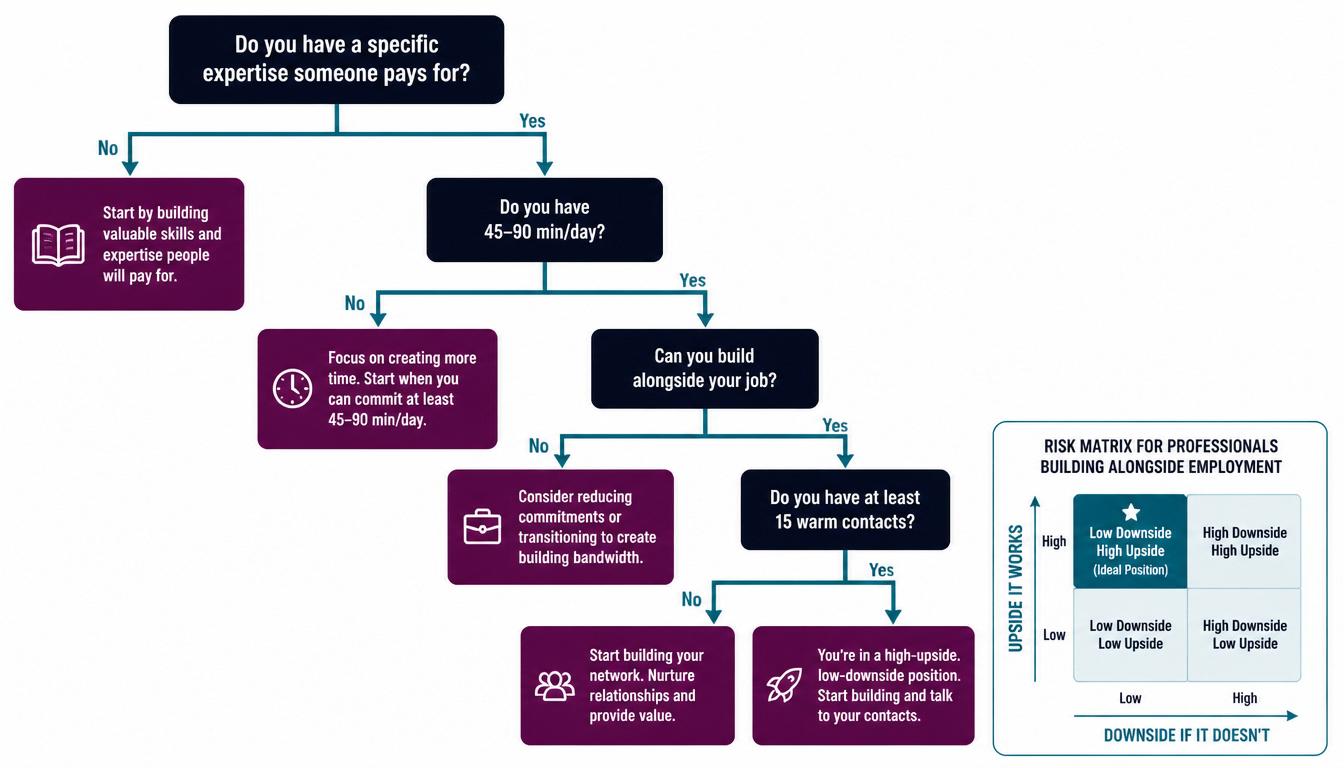
Most entrepreneurship content sits at one of two extremes when it comes to risk. The dramatic end – "quit your job, burn the boats, bet on yourself" – appeals to people who have already decided and need permission, not people who are seriously evaluating. The dismissive end – "what's the worst that could happen?" – is simply dishonest about the real costs of a failed attempt when you have financial obligations, a professional reputation, and family responsibilities.
Neither extreme is useful for a professional in their late 30s or 40s who is weighing a serious decision.
The risk framework that makes sense for this situation has three components:
- Build alongside your current job, not instead of it. The majority of successful digital businesses built by professionals were built over evenings, weekends, and early mornings while the builder was still employed. Income security removes desperation, and desperation produces bad decisions – underpricing, targeting the wrong audience, rushing to monetize before there is enough trust built. The overlap period is not a compromise. It is a strategy.
- Define your minimum viable success threshold before you start. Not an aspiration – a concrete number. "If I am generating ₦150,000 per month in additional income by month nine, I will expand. If I am not generating at least ₦60,000 by month six, I will diagnose and pivot rather than continue the same approach." Specific thresholds protect you from both giving up too soon and continuing too long with something that is not working.
- A digital business is not an all-or-nothing bet. You are not choosing between your career and a startup. You are adding an income stream. The decision about whether that income stream eventually replaces your salary is a decision for month 18 or 24, not month one.
Risk assessment – three questions to answer honestly
- What is the minimum income from this business that would make the time investment worthwhile – and by when?
- What is the realistic downside if the first attempt does not work? (Loss of time, not loss of career or capital, for most professionals.)
- What would need to be true at month twelve for you to feel that this was worth starting?
The TRE Framework: Reframing What You Already Have
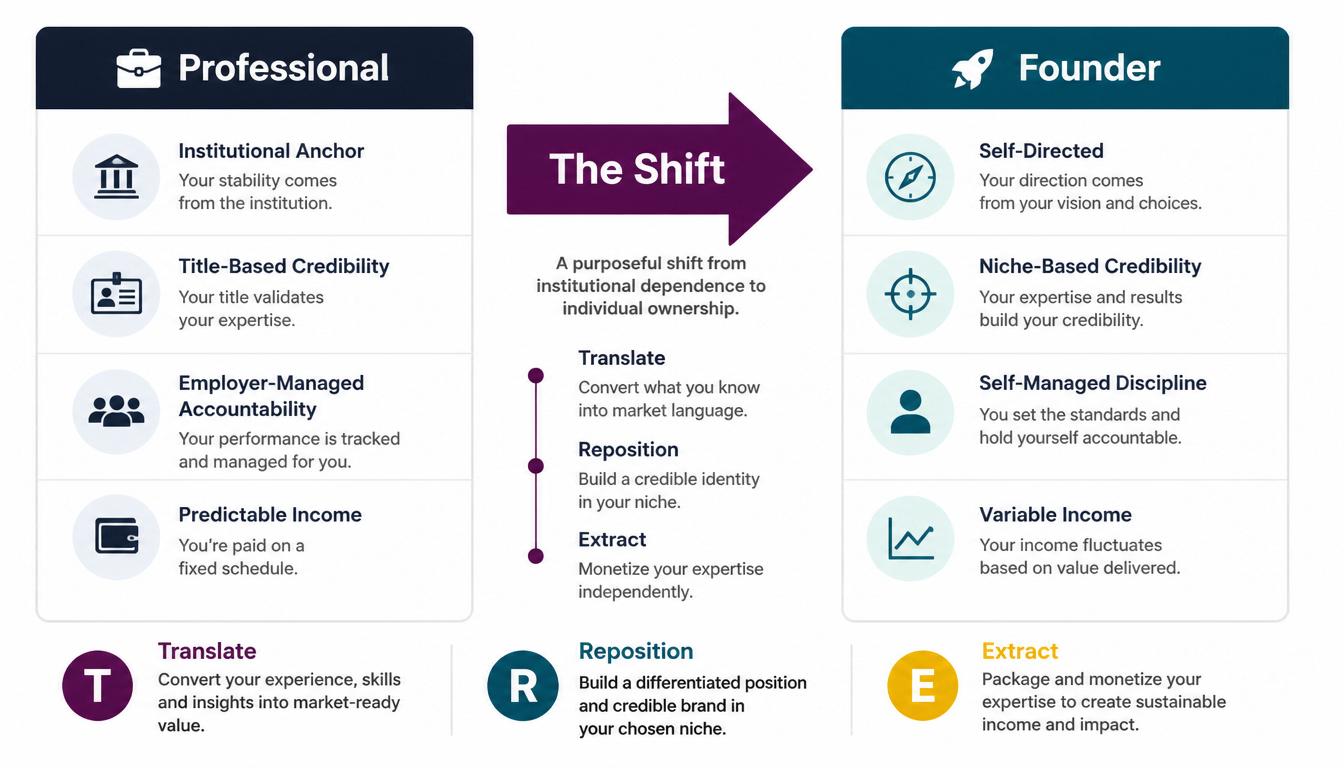
Most professionals approaching a digital business feel as though they are starting from zero. They are not. The TRE framework – Translation, Repositioning, Extraction – is a structured way to surface the business assets that already exist inside a professional career.
Take what you do inside an organization and translate it into a form that someone outside an organization can use. Your ₦200,000/month salary reflects the value of your expertise applied internally. Translation asks: what is that expertise worth when applied directly to a problem someone is paying to solve externally?
Your job title is not your market position. "Senior HR Business Partner" is a job title. "The person who helps growing SMEs build people systems before they break" is a market position. Repositioning means finding the intersection of your professional experience and an external market problem – and naming that intersection clearly.
Your career contains embedded knowledge that you have never formally documented. Frameworks you use instinctively. Processes you could teach but have only ever applied. Templates and models you have built over years and store in your own files. Extraction is the process of making that implicit knowledge explicit enough to package and sell.
| Component | What It Involves | The Key Question | Output |
|---|---|---|---|
| Translation | Converting internally-applied expertise into externally-sold value | What is my expertise worth when sold directly to the people who need it? | A product or service framing that speaks to buyer outcomes |
| Repositioning | Moving from job title to market position | What external market problem sits at the intersection of my experience? | A clear niche statement that a buyer immediately recognises |
| Extraction | Making implicit knowledge explicit and packageable | What frameworks, processes, and tools do I use that I have never formally documented? | A documented asset that can be sold as a product or packaged into a service |
The TRE framework is built around a single observation: professionals who struggle to identify what to sell are almost never short of expertise. They are short of a structured way to look at what they already have and see it through a buyer's eyes.
Let's bring this to life across a few professional backgrounds:
The implicit expertise: financial planning, cost control, scenario analysis. The market: founders who are drowning in numbers they do not understand.
The implicit expertise: policy design, performance management, onboarding. The market: founders hiring their first 10 employees with no framework for doing it well.
The implicit expertise: positioning, campaign strategy, market sizing. The market: SME brands that are strong locally but invisible regionally.
The implicit expertise: regulatory navigation, documentation, risk assessment. The market: founders who lose money to avoidable compliance gaps every year.
| Background | Market Position | Target Buyer |
|---|---|---|
| Finance | Financial modelling & cashflow guides for SME owners who cannot afford a full-time CFO | Lagos-based founders drowning in numbers they do not understand |
| HR | People operations playbooks for fast-growing startups with no formal HR function | Founders hiring their first 10 employees with no framework for doing it well |
| Marketing | Brand and go-to-market strategy for African consumer brands expanding beyond their home market | SME brands strong locally but invisible regionally |
| Legal/Compliance | Regulatory compliance toolkit for Nigerian MSMEs navigating FIRS, CAC, and NAFDAC | Founders losing money to avoidable compliance gaps every year |
In each case, the expertise was already there. What the TRE framework provides is the reframe that makes it visible – and sellable.
Questions About the Professional-to-Founder Transition
Is entrepreneurship for everyone?
No – and that is not a discouraging answer, it is an honest one. Entrepreneurship suits people who are comfortable with delayed certainty and who can make decisions without a committee. Most professionals have more of these qualities than they realize. The ones who thrive are rarely the most courageous – they are the ones who planned carefully and built income before they abandoned security.
How do I handle what colleagues think when I start a business?
Most colleagues will be privately curious and publicly cautious. Build quietly alongside your job. Let results speak before you broadcast. By the time there is something meaningful to discuss, you will have moved past needing their approval – and the conversation will be considerably easier.
Can I keep my professional identity while building a digital business?
Yes – and you should. Your professional identity is the foundation of your credibility, and credibility is what buyers of knowledge products pay for. You are not leaving your expertise behind. You are adding a new context in which to deploy it. That is not a reinvention – it is an extension.
What if the digital business doesn't work?
Define "doesn't work" before you start. Set a concrete milestone – by month six, X sales at Y price. If you do not hit it, diagnose: was it the niche, the pricing, the marketing, or the product? Most first attempts teach you exactly what version two needs to be. The professionals who "fail" at a digital business usually succeed with their next, better-positioned offer.
Put these into practice
Keep reading
The Digital Business Primer: Everything You Need to Know Before You Build, Launch, or Sell
You have spent years building a career. This guide is about what to do with that experience – without the tech paralysis, the wrong platform, or the wasted months building something nobody asked for.
What Digital Products Can You Actually Sell? A Guide for Professionals
Not every digital product suits every professional. Businease | Build with Ease breaks down what to sell, who each type suits, and how to choose the right one for your expertise.
Get the playbook in your inbox
One short, useful email per week — frameworks, templates, and lessons from solopreneurs in the trenches. No spam, unsubscribe anytime.