The Digital Business Primer: Everything You Need to Know Before You Build, Launch, or Sell
You have spent years building a career. This guide is about what to do with that experience – without the tech paralysis, the wrong platform, or the wasted months building something nobody asked for.
You have watched three colleagues get retrenched in the last eighteen months. One of them was more senior than you. You have also watched more than one person build something on the side that now pays them more than their salary did.
At some point, the career you built stopped feeling like a path and started feeling like a position. You are good at what you do - the kind of good that takes five, ten, fifteen years to become - and yet the ceiling is exactly where it was last year. The salary increment did not keep pace with what your rent did. The role you were right for went to someone with a different relationship with the person who made the decision. And meanwhile, the naira - or the cedi, or the shilling - is quietly doing what it has been doing for years.
You are not looking for an escape. You are looking for a second foundation. And this guide is about how to build one - specifically, using what you already know, without quitting anything, and without spending six months building the wrong thing.
This is a practitioner's guide for people who already have the substance and need the structure. We will cover the business models, the validation approach, the platform question, the pricing trap, and the first 30 days – in enough detail to give you a real foundation and not just inspiration.
What "Starting a Digital Business" Means – for Someone Like You
A digital business for professionals is a business that packages your specific expertise into a format that can be sold and delivered online, repeatedly, without trading your time on a 1:1 basis every single time. It is not freelancing with a website. It is not consulting under a new name. It is a model where your knowledge does work while you are doing something else.
That is the distinction that matters. Freelancing scales with your hours. A digital business scales with distribution. You build the course, the template, the coaching program, the toolkit once – and it can be sold to the 5th customer with almost no additional effort beyond what you invested for the 1st.
Three properties define whether something is a digital business. It is scalable: the unit cost of each additional customer is near zero. It is deliverable online: the buyer receives value through a screen, not necessarily through your presence in a room. And it is not purely time-for-money: there is a product – something fixed, packaged, and purchased – not just an hourly rate applied to whatever the client needs that week.
Why does this matter specifically for professionals? Because professionals – by definition – have the hardest part already done. You have the intellectual property. You have the credibility. You have the track record. What you are missing is not expertise. It is the packaging and distribution infrastructure. And that gap is much smaller than it looks from the outside.
Adaeze is a tax compliance manager at a mid-size firm in Lagos. She has spent eleven years navigating FIRS requirements, VAT filing complexities, and the practical gaps between what the regulations say and what businesses can execute. Every month, at least three founders in her network ask her some version of the same question: "How do we stay compliant without the overhead of a full-time tax team?"
That question is a product waiting to be built. Adaeze is not missing knowledge but the framework to turn what she knows into something she can sell.
The Five Digital Business Models – And Which One Fits Where You Are
There is no universally correct model. The right choice depends on how much time you have to create upfront, how large your existing network is, and what kind of ongoing commitment you can sustain alongside your current work. Here are the five models that are viable for professionals – assessed honestly.
High creation effort upfront, high scale potential. You build a structured curriculum – video, audio, written – and sell access repeatedly. Best for professionals with a systematic, teachable process. Requires patience with content creation; not ideal if you need income in the next 60 days.
Lower creation effort, time-intensive delivery, premium pricing. You sell your diagnostic skill and your attention in structured sessions. Best for those with specific transformation to guide. Still trades time, but at multiples of a day rate – and positions you for productization later.
Low creation relative to value, highly scalable, works without an existing audience. Spreadsheets, frameworks, policy documents, checklists – proprietary tools that solve a defined problem. This is the fastest path to a first sale for most professionals and is consistently underestimated.
Recurring revenue, requires ongoing content and community management. Better as a second or third product rather than a starting point. Your audience needs to trust you before they pay a monthly fee. Build the audience first; launch the membership later.
| Model | Creation Effort | Scale Potential | Time to First Sale | Best Starting Point |
|---|---|---|---|---|
| Online Courses | High | Very high | 60–120 days | If you have a teachable system and time to build |
| Coaching & Consulting | Low | Limited (time-bound) | 7–21 days | Strong network + diagnostic skills |
| Templates & Toolkits | Low–Medium | High | 10–30 days | Most professionals – fastest validated path |
| Membership Communities | Medium (ongoing) | High (recurring) | 90+ days | Best as 2nd or 3rd product, not first |
| Productized Services | Low | Medium | 14–30 days | Consulting background with repeatable deliverable |
The fifth model – productized services – deserves its own mention. This is where you take something you currently deliver as bespoke consulting and standardize it: fixed scope, fixed deliverable, fixed price. A financial audit package for SMEs at ₦250,000. A 90-day HR policy documentation service at ₦180,000. You are still delivering work, but it is predictable work – and that predictability is the beginning of a product business, not the end of one.
How to Know If Your Expertise Is Sellable Online
This is the question most people avoid asking directly because the answer feels too uncertain. Let me make it more concrete. Your expertise clears the bar for a digital business if it passes three tests: specificity, transferability, and external proof.
- Specificity: you can describe what you know in a sentence a non-expert would understand and immediately recognise as valuable. "I know about HR" is not specific. "I know how to reduce first-year employee turnover in manufacturing businesses without a formal HR department" is specific – and sellable.
- Transferability: the knowledge can be packaged in a form someone else can learn from, apply, and achieve a result with – without you standing next to them. If what you do is mostly intuition, judgment, and reading the room, you need to make it explicit before you can package it. That process of making the implicit explicit is the first act of building a digital product.
- External proof: someone has paid for this knowledge before – directly or indirectly. If your employer has been paying you a salary to apply this expertise, that is proof. If colleagues seek your input on this topic, that is proof. If people in online forums are asking the questions you know the answers to, that is proof. You do not need a testimonial page to start. You need evidence of existing demand.
The most reliable way to verify demand before building anything is to search for your core topic on LinkedIn, on Quora, and on relevant professional forums. Count the questions. Assess the quality of existing answers. If there are many questions and mostly mediocre answers, you have found your gap. And no – it is almost never too late. The professional knowledge economy in Africa is barely touched. The professionals who are ahead of you are not ahead by much, and they are not competing for your specific niche.
The Platform Problem – And How to Stop It From Paralyzing You
Platform choice is the most over-researched, under-decided question in the early stages of a digital business. You have probably already seen the comparisons. Kajabi versus Podia versus Teachable versus Thinkific. Gumroad versus Payhip. You have watched YouTube reviews and read feature matrices and still not started.
Here is what matters when choosing a platform at the beginning. Three questions only:
- Does it accept payments from your buyers? For most professionals in Nigeria, Ghana, Kenya, or South Africa, this means confirming whether the platform integrates with Stripe (available in an expanding number of African countries), PayPal, or a payment gateway you can actually access. Gumroad accepts PayPal and card payments and pays out via PayPal – functional for most African sellers. Flutterwave and Paystack are integrated with some platforms; check before you commit.
- Does it deliver your product type? A file download product (template, PDF toolkit) needs a different platform from a structured video course. Gumroad and Payhip handle file products extremely well. Teachable is built for structured courses. Know what you are selling before choosing your shelf.
- Can you get started in under a week? If the platform requires a month of onboarding before you can take your first payment, it is the wrong platform for now. Simplicity at the start is a strategic choice, not a compromise.
Emeka runs a logistics consultancy in Abuja. He wants to sell a pricing toolkit for freight and haulage businesses – a spreadsheet-based model he has refined over six years. He does not need a course platform, a membership system, or a landing page builder with 47 templates. He needs somewhere to upload a file, set a price, and take payment. Gumroad does this in an afternoon.
Six months later, if he is making consistent sales and wants to build a course on freight pricing strategy, that is the time to evaluate Teachable or Podia. Not now.
For the majority of professionals starting out, the practical recommendation is: Gumroad or Payhip for simple product delivery; Teachable if video courses are the core format from the beginning. One platform. Set it up imperfectly. Sell something. Everything else is optimization.
The Pricing Trap – Why Professionals Underprice and How to Stop
This is the pattern I see consistently: professionals with a decade or more of domain expertise price their first digital product as though they are apologizing for existing. A ₦15,000 guide. A $27 course. A template priced at whatever feels "not too much." The logic is usually some version of: "I just want people to try it" or "I'm not sure it's worth more."
Here is what price communicates before a buyer reads a single word of your content: it signals the quality tier you are in. A ₦8,000 product and a ₦75,000 product attract different buyers with different expectations, different levels of seriousness, and different likelihoods of implementing what they learn. Paradoxically, underpricing can result in more refund requests and fewer testimonials – because the people who pay the least often invest the least attention.
Three pricing frameworks work reliably for knowledge products:
- Outcome-based pricing: anchors your price to the result you deliver, not the hours you spent producing the content. If your tax compliance toolkit helps a Lagos MSME avoid a ₦500,000 penalty, what is the right price for that? Probably not ₦12,000.
- Market positioning pricing: starts with research – what do comparable knowledge products in your space sell for? – and then places you intentionally on the quality spectrum. Price yourself below the market and you inherit the low-quality perception that comes with it. Price yourself at or above the market and you need to deliver accordingly.
- Ladder pricing: the long game. An entry product (₦10,000–₦30,000) that builds trust and delivers a specific result, a core product (₦75,000–₦200,000) that delivers the main transformation, and a premium offer (₦250,000+) for those who want direct access to you. The entry product is a trust-building investment, not a profit center. Most professionals skip the ladder and start with only the core product – which means they miss the buyers who are not yet ready to commit at that level.
| Tier | Price Range | Purpose | Typical Format |
|---|---|---|---|
| Entry | ₦10,000–₦30,000 | Build trust; capture buyers not yet ready to commit at higher tiers | Template, checklist, short guide |
| Core | ₦75,000–₦200,000 | Deliver the main transformation; primary revenue driver | Full course, coaching program, toolkit bundle |
| Premium | ₦250,000+ | Direct access to you; highest-value buyers only | 1-on-1 consulting, done-for-you service, mastermind |
Your First 30 Days – A Minimal, Executable Roadmap
This plan assumes you have a full-time job and 45–90 minutes per weekday to dedicate to this. It is not a fantasy. It is a real sequence designed for real constraints.
- Days 1–3: Define your niche and target buyer in one sentence. Not a paragraph. One sentence: "[Target buyer] who struggles with [specific problem] and wants [specific outcome]." If you cannot do this, nothing else in the plan will work. This is not a marketing exercise – it is a clarity exercise.
- Days 4–5: Choose one product type and one platform. Templates or a coaching package for the product. Gumroad or Teachable for the platform. Make the decision and do not revisit it for 90 days.
- Days 6–10: Build a simple landing page with a lead magnet. A lead magnet is a free, high-value resource – a checklist, a one-page framework, a short guide – that solves one specific problem and captures an email address. Use Carrd (free tier) or your platform's built-in page. It does not need to be beautiful. It needs to be clear.
- Days 11–20: Create the minimum viable product. This is not the final version. It is the version that delivers the promised outcome. For a template product, this might be 3–5 days of focused work. For a short course, it might be recording 4–6 video lessons. Outline first; record or write second. Done is better than refined.
- Days 21–23: Set up payment and delivery. Connect your platform to a payment method. Test the end-to-end purchase flow yourself – buy your own product – before you send anyone else to it.
- Days 24–28: Soft-launch to people who already know you. Not a mass email. Individual messages to 15–20 people in your professional network who understand what you do. Offer a beta discount in exchange for feedback and a testimonial. Your goal is 3–5 sales and 2 testimonials, not 50 sales. The first sale is a milestone. What it proves – that someone values what you built enough to pay for it – matters more than the revenue at this stage.
- Days 29–30: Collect feedback, not perfection. Ask every buyer one question: "What was most valuable, and what would you add?" The answer shapes version two. Do not rebuild. Iterate.
The Tools You Actually Need – And the Ones That Are Just Distractions
The minimum viable tech stack for a professional starting a digital business is shorter than you think. You need one platform to sell and deliver (Gumroad, Podia, or Teachable), one email tool to start building a list (MailerLite or Brevo – both have free tiers that handle 500–1,000 contacts with no cost), one creation tool (Google Docs for writing, Canva for design, Descript or Loom if you are recording video), and one scheduling tool if you are offering coaching sessions (Calendly – free tier is sufficient).
What to ignore until you have your first 50 customers: a custom website, a CRM system, paid advertising, social media management tools, complex funnel builders. These are optimization tools. You cannot optimize what you have not yet built.
One note on AI tools – and this is worth saying plainly. Tools like ChatGPT and Claude have compressed the time it takes to go from expertise to content. A course outline that used to take two weeks of deliberate thinking can now take two hours of structured prompting. An email sequence that would have taken three days can take an afternoon. The caveat is equally plain: AI generates raw material. Your expertise is what makes it credible, specific, and trustworthy. A professional using AI is a force multiplier. AI without professional judgment is just confident noise.
The Question Nobody Tells You to Ask
Beneath all the practical questions – which model, which platform, which price – there is a more important one: is this worth it for you, specifically, given your situation?
A realistic first year for a professional building a digital business alongside a job looks something like this: the first three months are mostly building and low revenue. Months four through six usually yield the first consistent sales if you have been actively marketing. By month nine or twelve, a well-positioned professional with a validated product and a small but engaged audience can be generating ₦200,000–₦800,000 per month in additional income. Some do significantly more. Some plateau earlier. The range is wide because the variables – niche specificity, marketing consistency, and pricing confidence – matter enormously.
The three profiles of professionals who tend to build this faster share something: they have a clear and specific expertise, they are willing to be publicly associated with a niche (which requires some degree of comfort with being visible), and they have at least some existing professional relationships they can activate as a starting audience. If you score high on all three, you will move faster than average.
The honest failure modes are worth naming. Building a full product before validating that anyone wants it – extremely common, usually devastating to motivation. Choosing an audience that does not spend money on learning (some do not; research this). Expecting the revenue to be passive immediately – it is not passive in the first year; it is just more scalable than trading hours. And treating this like a hobby when you want business results.
The last thing to say – and it is not a motivational close, it is a structural observation – is that building a digital business while you are still employed is an advantage, not a compromise. You have income stability that allows you to test without desperation. Desperation produces bad pricing decisions, bad audience targeting, and an urgency that buyers can feel. You have the luxury of getting it right.
Quick self-check before you move
- Can you describe your niche in one sentence – who, what problem, what outcome?
- Is there evidence that people are already searching for or asking about this topic?
- Have you chosen one product type and committed to it for the next 90 days?
- Have you run the revenue numbers at your target price to confirm the model makes sense?
- Do you have at least 15 people in your professional network who know your expertise and might respond to a direct message?
Common Questions About Starting a Digital Business
Do I need an existing audience to sell digital products?
No. Most successful first customers come from direct personal outreach and professional networks – not social media followers. If you have 300 LinkedIn connections who know your expertise, you have a starting audience. Build the product, then reach out directly to the people who already trust you.
How much money do I need to start a digital business?
Under $50/month in most cases, and often zero in the first 30 days. Platforms like Gumroad and MailerLite have free tiers sufficient for the first 20–50 sales. The real investment is time – roughly 45–90 minutes per weekday over three months to build something worth selling.
Is it too late to start a digital business if I'm in my 40s or 50s?
No. Professional experience – the kind earned over 15 or 20 years – is the core asset in a knowledge-based digital business. Younger creators compete on volume and entertainment; you compete on depth, credibility, and specificity. Those are different markets, and yours is often the more profitable one.
How long before I make my first sale?
With active outreach to people who already know you, 30–90 days is realistic. Without outreach – if you publish and wait – it can take 6–12 months. The single biggest variable is whether you actively sell to warm contacts, or passively wait for strangers to discover you.
Do I need to be a tech expert to run a digital business?
No. Setting up a Gumroad storefront or a Teachable course page takes a few hours, not weeks. The skills that matter most – subject expertise, clear communication, professional credibility – are things you already have. The technology is simpler than it looks from the outside.
What if someone else is already selling what I know?
Competition validates demand. You are not selling the same thing as anyone else – you are selling your specific framework, your professional perspective, your particular approach to the problem. In a market as large and underserved as Africa's professional knowledge economy, competition is rarely the real barrier.
Keep reading
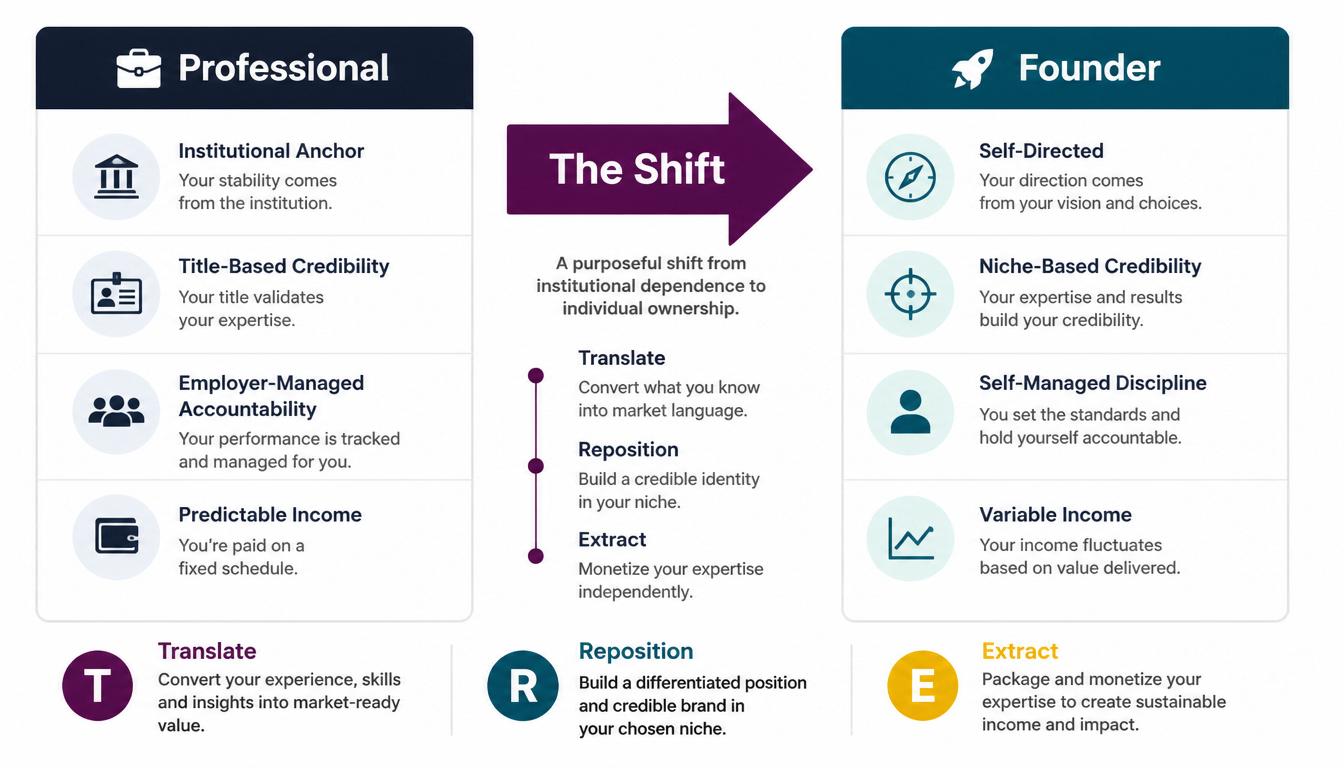
From Professional to Founder: The Identity Shift That Changes Everything
Career transition to entrepreneurship is harder than anyone admits. Businease | Build with Ease unpacks the identity shift – and why your professional pride is both asset and obstacle.
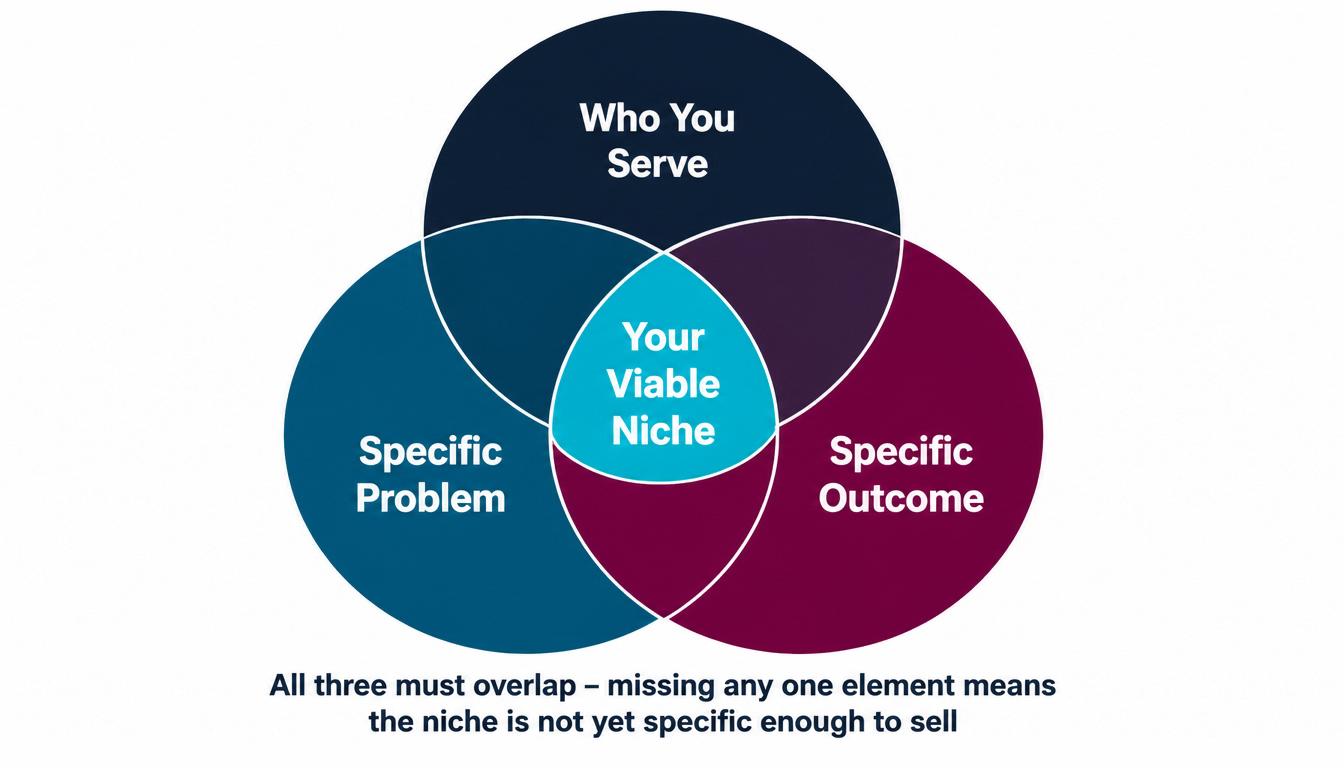
How to Find Your Niche and Validate Your Digital Product Idea
Building before validating is the most expensive mistake in digital business. Businease | Build with Ease shows you how to find your niche and confirm demand before creating anything.
Get the playbook in your inbox
One short, useful email per week — frameworks, templates, and lessons from solopreneurs in the trenches. No spam, unsubscribe anytime.