How to Build an Audience for Your Digital Business – Starting From Zero
You don't need 10,000 followers. Businease | Build with Ease shows you how to build an email audience from your professional network – the asset that converts better than any following.
Part of: Digital Business Primer →
The most paralyzing belief in digital business is also one of the most persistent: "I cannot sell anything until I have a large following." It is false, it is convenient, and it is responsible for more stalled digital businesses than any platform choice or pricing mistake ever could be.
Here is the reality for professionals. Your professional network – the colleagues, clients, former employers, and industry contacts you have accumulated over a career – is a pre-built audience. It is an audience that already trusts your expertise, already understands your field, and already has the professional context to recognise the value of what you are building. That is worth considerably more than 10,000 Instagram followers who discovered you through an algorithm and have no stake in your success.
This article is part of the Digital Business Primer. It covers the difference between a following and an audience, how to convert your professional network into an email list, what to send once you have subscribers, and how to grow beyond your existing contacts over time.
The Difference Between a Following and an Audience
| Dimension | A Following | An Audience |
|---|---|---|
| How it's measured | Follower count, likes, reach | Email addresses, direct replies, willingness to buy |
| Trust level | Algorithmically acquired, shallow | Permission-based, deep |
| Time to build | Months–years of content production | Days–weeks from professional network |
| Access to buyers | Algorithm-dependent (0.5–3% reach) | Direct – email opens at 30–45% |
| Conversion rate | 0.5–2% (social) | 3–10% (warm email list) |
| What a professional already has | Rarely | Almost always |
A following is people who find your content entertaining or interesting enough to click a follow button. An audience is people who trust your expertise, are experiencing the problem you solve, and are positioned to benefit from your product. A following is measured in follower counts. An audience is measured in email addresses, direct messages, and the willingness of real people to give you 20 minutes of their attention.
Professionals rarely have a "following" – not without deliberately building one. But they almost always have an audience. The 300 LinkedIn connections who have seen you present at a conference, collaborated with you on a project, or reached out for advice over the years – that is an audience. It is smaller than a following, and it is worth more.
How to Convert Your Professional Network Into an Email List
The mechanism is a lead magnet: a free, high-value resource that solves one specific problem for one specific person, delivered in exchange for an email address. The lead magnet is not a newsletter sign-up. It is a transaction – value for contact information – and it needs to be specific enough that the target buyer feels they would be foolish not to request it.
A strong lead magnet for a professional audience has four properties: it solves a problem your target buyer is experiencing right now; it delivers a result the buyer can recognise within 30 minutes of using it; it is specific enough to filter – people who are not your target buyer will not want it; and it is fast enough to consume that completing it does not feel like homework.
Creating a lead magnet in three days is realistic for most professionals. Day one: identify the single most useful framework, checklist, or model you have developed in your career, and write a one-page description of the problem it solves. Day two: build the resource – a Google Doc, a Notion page, a Canva-designed PDF, a simple spreadsheet. Day three: create the landing page (Carrd free tier), set up the email delivery (MailerLite free tier), and test the end-to-end flow yourself.
Sharing it with your professional network is not a mass email. It is a series of individual messages – WhatsApp, LinkedIn DM, or personal email – to people who know you and match your target buyer profile. "I put together a checklist for [specific problem] – thought it might be useful given what you mentioned about [relevant context]. Would you like me to send it over?" That is a personal outreach, not a broadcast. It converts significantly better.
Amaka is a pharmacist and regulatory compliance manager in Lagos. Her lead magnet is a NAFDAC registration readiness checklist for Nigerian food and supplement businesses – a one-page PDF that saves a first-time applicant at least two rejected submissions.
She shared it personally with 22 people in her professional network over three days. 17 of them requested it. 14 subscribed to her email list. Three of those 14 became paying customers for her compliance consulting package at ₦180,000 within six weeks. Her email list – not her follower count – was the business asset.
What to Send Your Email List Once You Have It
The second fear is smaller but equally common: "I have email addresses but I do not know what to send." The answer is a five-email welcome sequence, written in a week, automated in MailerLite, and running on its own from day one.
- Email 1 (immediately on sign-up): Deliver the lead magnet. Introduce yourself in two sentences – your professional background and the specific problem you help people solve. Thank them for subscribing; do not over-promise.
- Email 2 (day 3): A useful insight or framework – one thing they can apply immediately that relates to the problem your product addresses. This is not a pitch. It is a demonstration of value.
- Email 3 (day 6): A case study, scenario, or example – how someone with your buyer's problem navigated it successfully. The story format builds trust in a way that frameworks alone cannot.
- Email 4 (day 10): An honest look at the problem – why it persists, what makes it hard to solve without outside expertise, and what the cost of not solving it tends to be.
- Email 5 (day 14): Introduce your product. Not as a pitch – as a natural conclusion to the four emails that came before it. "If you are dealing with [problem], here is what I have built to help."
Write these five emails. Automate them. Then continue sending to your list weekly or fortnightly – insights, frameworks, observations, scenarios. The list is your most valuable business asset. Treat it accordingly.
Growing Beyond Your Existing Network
Once the foundation is in place – lead magnet live, welcome sequence running, list at 50–200 subscribers – three channels reliably expand it. LinkedIn organic posting, done consistently at 2–3 times per week, will surface you to connections' connections and occasionally reach non-connected professionals searching for your topic. Each post can reference the lead magnet naturally, converting readers into subscribers.
Guest appearances on industry podcasts and professional association events position you as an authority in front of an audience that has already opted in to hearing about your field. One guest appearance on a podcast with 2,000 regular listeners – listeners who are professionals in your target market – is worth significantly more than 10,000 social media impressions from people with no specific interest in your niche.
A referral mechanism among your first buyers is the most under-used growth tool in professional digital business. Every buyer knows people who have the same problem they just paid you to help with. A simple message after delivery – "If you know anyone else dealing with [problem], I would appreciate the referral" – converts real relationships into warm leads at near-zero cost.
Questions About Building an Audience
What is a good open rate for emails?
In the professional knowledge product space, 30–45% open rates are achievable with a warm, permission-based list. Below 20% typically indicates that the content is not relevant to the subscribers you have, that the subject lines are weak, or that the list contains a significant proportion of people who signed up for a lead magnet and have since disengaged. Clean your list every 60–90 days – remove subscribers who have not opened in that period.
How often should I email my list?
Weekly is the frequency that builds habit without being perceived as excessive by a professional audience. Fortnightly is acceptable if each email is substantive. Less than once a month and you lose the relationship – subscribers forget who you are between sends. More than twice a week and you risk fatigue in a professional inbox. Start weekly. Adjust based on unsubscribe rates.
What is the best free email tool for a first-time digital business?
MailerLite's free tier supports 500 subscribers and 12,000 monthly emails – more than sufficient for the first year. It has automation capabilities, landing page building, and clean analytics. Brevo (formerly Sendinblue) is an alternative with a larger free tier. Both are reliable for African users and do not require a credit card to start.
What if I only have 50 subscribers?
50 engaged subscribers who match your target buyer profile are worth more than 5,000 loosely interested people. Focus on quality over quantity. Send every email as though it is going to a small group of serious professionals – because it is. The number grows when the content earns it.
Put these into practice
Keep reading
The Digital Business Primer: Everything You Need to Know Before You Build, Launch, or Sell
You have spent years building a career. This guide is about what to do with that experience – without the tech paralysis, the wrong platform, or the wasted months building something nobody asked for.
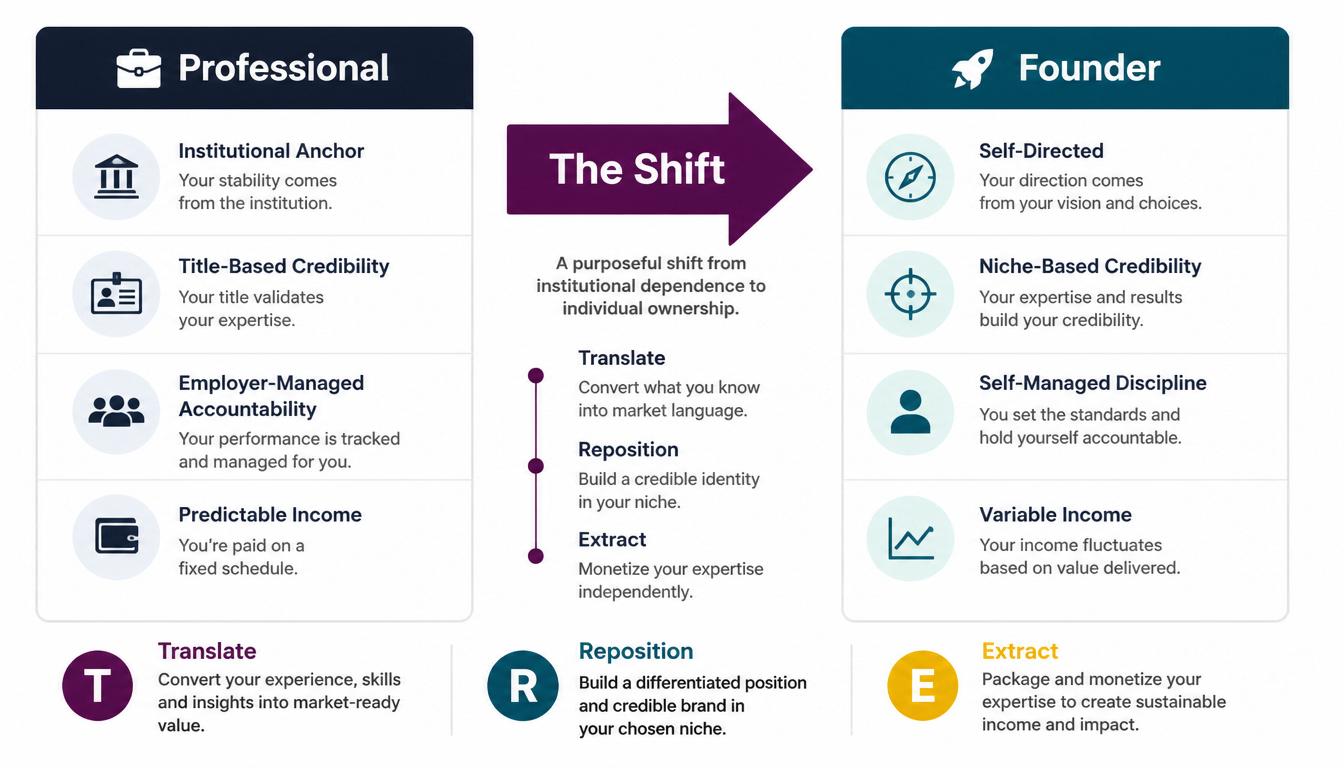
From Professional to Founder: The Identity Shift That Changes Everything
Career transition to entrepreneurship is harder than anyone admits. Businease | Build with Ease unpacks the identity shift – and why your professional pride is both asset and obstacle.
Get the playbook in your inbox
One short, useful email per week — frameworks, templates, and lessons from solopreneurs in the trenches. No spam, unsubscribe anytime.