How to Price Your Digital Products Without Undervaluing Your Expertise
Professionals almost always underprice their first digital product. Businease | Build with Ease gives you three pricing frameworks that reflect real expertise value – not imposter syndrome.
Part of: Digital Business Primer →
There is a pattern that appears consistently among professionals launching their first digital product: the ₦8,000 pricing. A finance director with twelve years of experience. A supply chain specialist who has spent a decade building procurement frameworks that save companies millions. A senior HR business partner who knows exactly why companies lose their best hires in the first 90 days. Each of them prices their first product at ₦8,000 – or $27, or whatever number felt "not too much." The logic is always some version of: I just want people to try it. I'm not sure it's worth more yet.
Here is what low pricing actually communicates before a buyer reads a single word of your content: it signals the quality tier you occupy. And low-quality positioning attracts low-quality buyers – people who are price-sensitive, less committed to implementation, and less likely to generate the testimonials that sell your next product.
This article is part of the Digital Business Primer. It covers why professionals systematically underprice, three frameworks that correct this, how your buyers' psychology relates to price signals, and how to test and adjust your pricing without committing permanently to a number that does not serve you.
Why Professionals Systematically Underprice
The root cause is a framework mismatch. Professionals are trained – by years of salary negotiations, day-rate conversations, and hourly billing – to anchor their value to time. If building the course took 60 hours, and they currently earn the equivalent of ₦15,000 per hour, the product feels like it should cost ₦900,000. That feels absurd. So they swing to the other extreme and price it at ₦15,000.
Both anchors are wrong. The buyer is not paying for your hours. The buyer is paying for the outcome your product delivers – and the alternative cost of reaching that outcome without your help.
An onboarding system guide that reduces first-year employee turnover by 20% is worth, to a Lagos MSME owner spending ₦180,000 to replace each departing employee, some fraction of the annual replacement cost it prevents. The hours you spent writing it are irrelevant to that calculation. Pricing based on hours spent is the most reliable way to leave significant money on the table.
Three Pricing Frameworks for Knowledge Products
Anchor your price to the result you deliver, not the time or content that delivers it. Ask: what is the cost of the problem your buyer has right now? What is the financial or professional value of the outcome they receive if your product works? Price at 10–25% of that value. A procurement toolkit that saves a buyer ₦500,000 annually in overpayments is reasonably priced at ₦50,000–₦125,000 – not ₦15,000. The calculation is not complicated. Most professionals simply never do it.
Research what comparable knowledge products in your space sell for, then choose where you want to sit on the quality spectrum deliberately. Pricing below market does not attract more buyers – it attracts bargain hunters and signals low quality to the serious buyers you want. Pricing at or slightly above market requires you to deliver accordingly, which is a productive constraint. Never price below market without a strategic reason. "I am not confident" is not a strategic reason.
The ladder is a sequence of offers at escalating price points, each serving a different stage of buyer readiness. Entry product (₦10,000–₦30,000): a specific, contained tool or guide that delivers one tangible result and builds initial trust. Core product (₦75,000–₦200,000): the main transformation – a full course, a structured program, a comprehensive toolkit. Premium offer (₦250,000+): direct access to you – coaching, consulting, done-with-you implementation. The entry product is a trust investment. The core product is where the business lives. The premium offer is where the relationship deepens.
| Framework | How to Apply It | Best For | Common Mistake |
|---|---|---|---|
| Outcome-Based | Price at 10–25% of the value your product delivers to the buyer | Products with a quantifiable financial outcome (cost savings, revenue gains) | Never doing the calculation – and defaulting to a "feels reasonable" number instead |
| Market Positioning | Research comparable products, then choose your position on the quality spectrum deliberately | Established markets where comparable products already exist and set buyer expectations | Pricing below market because of low confidence rather than strategy |
| Ladder Pricing | Create entry (₦10k–30k), core (₦75k–200k), and premium (₦250k+) tiers at escalating price points | Professionals building a long-term product business with multiple buyer segments | Building only an entry product and never moving buyers toward the core offer |
Pricing benchmarks – Nigerian professional market
The Psychology of Price for a Professional Audience
Your buyers are professionals too. Many of them have budget authority. They make purchasing decisions at work that involve multiples of what you are charging. They know that cheap does not mean accessible – it means unserious. The person who buys your ₦15,000 course and the person who buys your ₦150,000 course are different people, with different levels of commitment to implementation, and different consequences attached to the outcome.
The ₦150,000 buyer is more likely to complete the course. More likely to implement the framework. More likely to see results – because the investment creates psychological commitment to getting the return. More likely to leave a testimonial. More likely to refer a colleague. That is not counterintuitive. It is buyer psychology, and it is consistent across professional markets.
Ngozi is a financial consultant in Abuja who built a cashflow management course for Nigerian SME owners. She initially priced it at ₦18,000 because she worried that more would be "too much." She sold 11 copies. Six buyers completed the course; three left reviews.
She raised the price to ₦85,000 and added a 30-minute implementation call. She sold 7 copies in the following two months. All 7 completed the program. Five left detailed testimonials. Two became coaching clients at ₦250,000 each. The revenue from those two clients exceeded her entire first year of sales at ₦18,000.
How to Test Your Price Without Committing Permanently
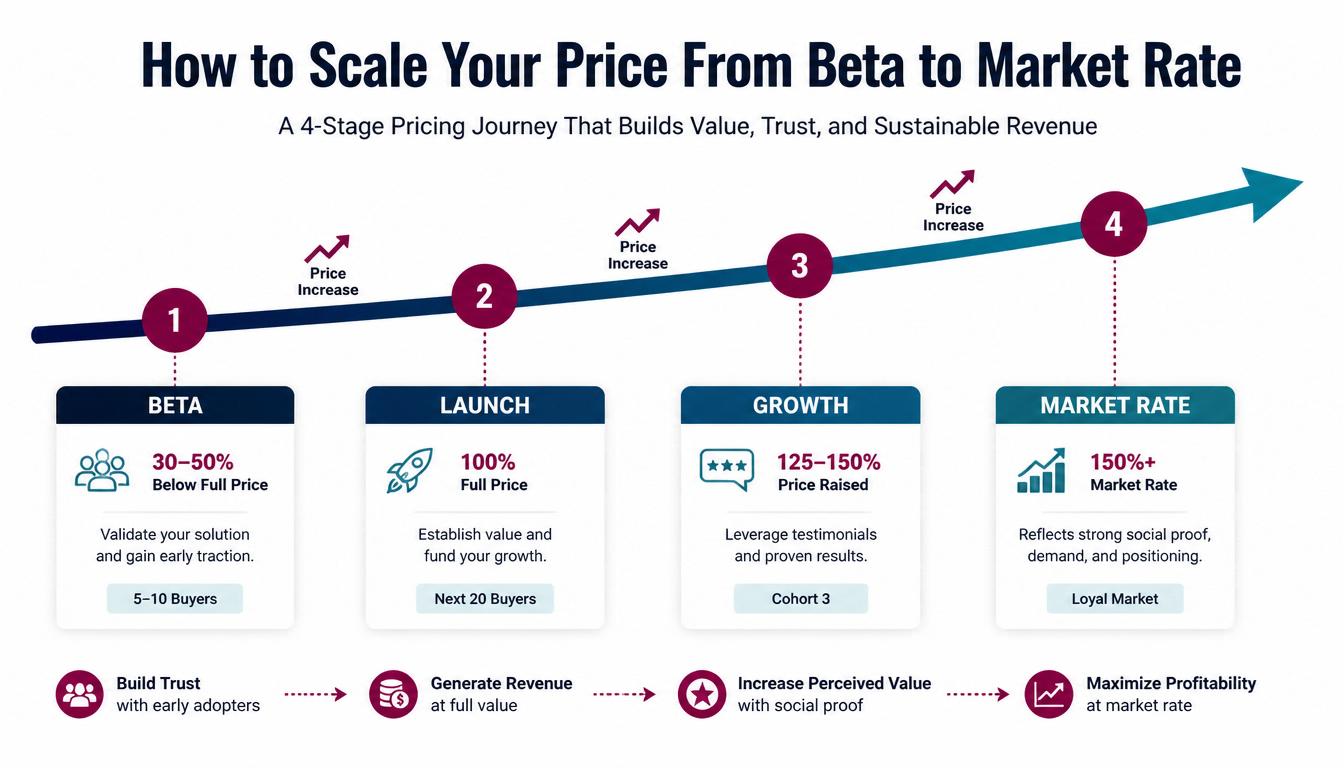
Price is a variable, not a fixed decision. Here is a practical approach to testing pricing without overcommitting to a number that does not work: pre-sell at a beta price (30–50% below your intended full price) to the first 5–10 buyers, explicitly framed as an early-access discount. This gives you paying customers, feedback, and testimonials, while retaining the flexibility to raise the price after launch.
Analyse what happens at each price point as you scale. A high refund rate signals a mismatch between the price promise and the product delivery – or the wrong audience at that price, not necessarily a price that is too high. A very low conversion rate on a landing page with good traffic signals either a price that is too high for the audience you are reaching, or an audience that is not the one you intended to reach.
Raise the price with each cohort. Your first 10 buyers pay the beta price. Your next 20 pay the launch price. As testimonials accumulate and the product improves, the price reflects the growing evidence of value. This is a normal trajectory – not a bait-and-switch.
Questions About Pricing Digital Products
Should I offer a free version first to build an audience?
Only if the free version is a genuine lead magnet – a contained, high-value resource that solves one specific problem and captures an email address. Giving the full product away for free trains your market to undervalue you and attracts people who were never going to pay. Free has a strategic role. It is not a substitute for confident pricing.
What if nobody buys at my price?
Low conversion is almost never purely a price problem. Before reducing your price, check: Are you reaching the right audience? Is the outcome clearly described? Have you built enough trust for someone to hand over money? In most cases, one of these three is the issue – not the price itself. Discounting before diagnosing is a fast way to train buyers to wait for sales.
How do I justify raising my price after launch?
You do not need to justify it – you need to announce it. "The launch price was ₦25,000. From [date], the price moves to ₦45,000." Existing buyers feel they got a deal. Prospective buyers have a reason to move now. Price increases after launch are a normal part of building a product business.
What is the minimum price worth selling a digital product at?
In the Nigerian professional market, a useful guide: entry products ₦10,000–₦30,000, core products ₦75,000–₦200,000, premium packages ₦250,000+. Below ₦5,000 for a paid professional product, you are likely attracting the wrong buyers and signalling that the product is not serious. Price signals quality before the buyer reads a word of your content.
Put these into practice
Keep reading
Strategy Tools for African Businesses: A Primer
5 questions strategy helps small businesses answer - and the tools to act on each one.
Too Small for Structure? 7 Small Business Myths Debunked
You're praying for hundredfold growth but running a one-person chaos system. Something has to give.
Get the playbook in your inbox
One short, useful email per week — frameworks, templates, and lessons from solopreneurs in the trenches. No spam, unsubscribe anytime.